Learn it once. Keep it for life.
Qenot brings back what you study before you forget it, then lets you face the test before it happens.
Free to start. No card.
Most of what you learn fades in a week, unless it comes back at the right time.
The forgetting curve (Ebbinghaus) and the spacing effect (Cepeda et al., 2006).
Remember
A few minutes a day.
Each card comes back just before you'd forget it.
Prove it
Sit the exam before the exam.
Past papers on the clock, every answer marked.
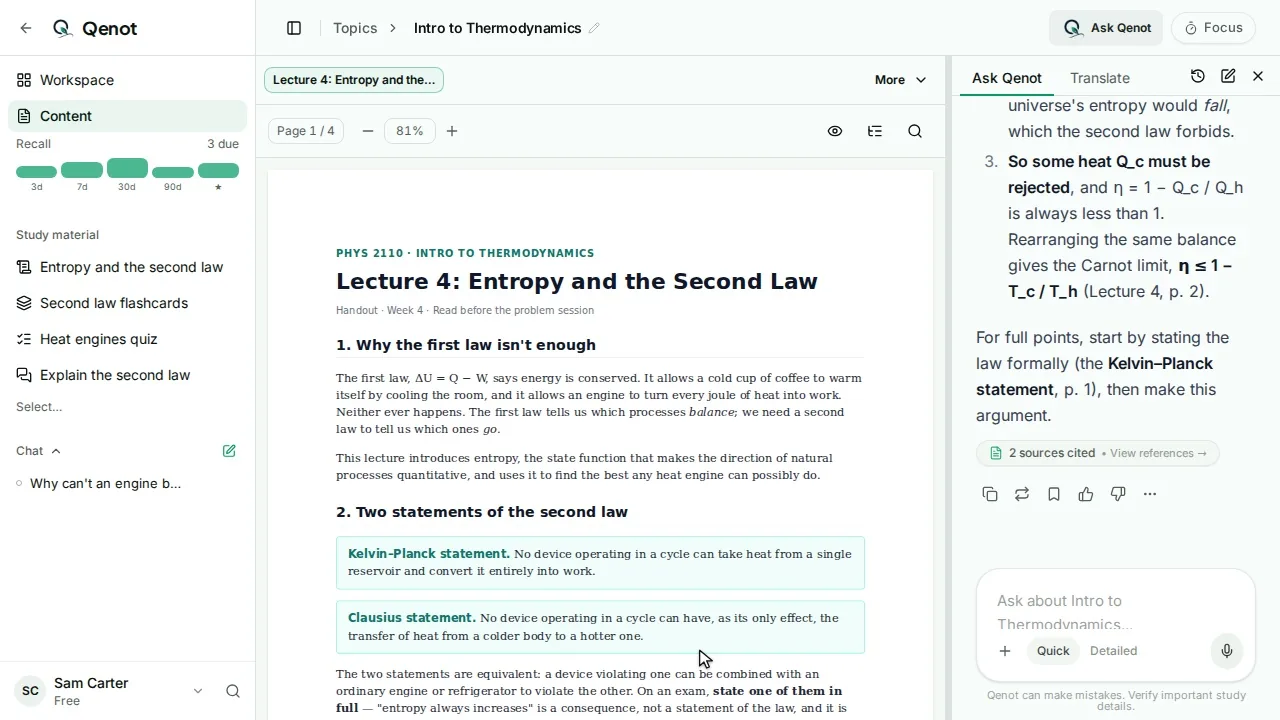
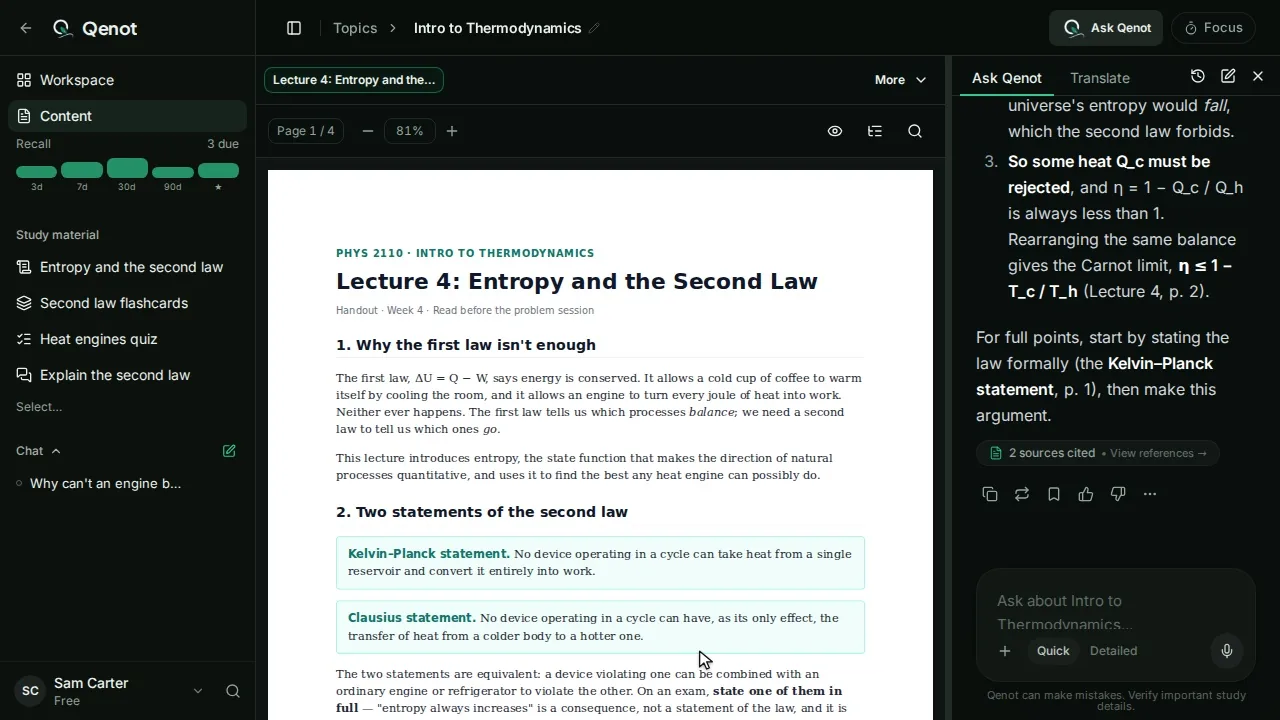
See a marked reportOne window. Nothing to switch to.
Highlight it, ask about it
A calm focus timer
Explain it back
Flashcards, quizzes and notes from your lectures
How it works
Add your lectures
PDFs, slides, links or notes.
Practise a little each day
Recall picks what's about to fade.
Prove it before the test
Sit past exams, see what to fix.
Built on how memory works.
61%vs 40%
remembered a week later by students who practised recalling, against those who reread.
Roediger & Karpicke, 2006
2 of 10
study methods rated highly effective: practice testing and spacing it out.
Dunlosky et al., 2013
25 min
focused blocks with short breaks keep attention up for longer.
Cirillo, the Pomodoro Technique
Yours, and honest about it.
Marking you can check
A reason for every point, beside a model answer.
Yours alone
Private to your account. Delete anything, anytime.
No ads, ever
We don't sell your data.
Marking is study guidance, not an official grade. Privacy policy
Start free. Upgrade when you need more.
Questions
Before you sign up
How does Qenot help me remember?
Everything you study becomes cards and questions you answer from memory. Recall brings each one back just before you'd forget it, a little later every time you get it right, so a few minutes a day keeps a whole course fresh.
Is it only for exams?
No. Exams are one test; interviews, presentations and conversations are others. Keep anything you learn as a topic, review it in Recall, and practise it before it's tested.
How accurate is the grading?
It grades against a rubric and shows you the reason for every point, plus a model answer, so you can judge it yourself. Think of it as a strict study partner, not your instructor: it's study guidance, not an official grade.
What kinds of exams work?
Anything with written questions: short answers, long answers, calculations and multiple choice. Upload it as a PDF or a photo. Diagrams in the questions are kept, and diagrams you draw in your answers are read too, as long as the photo is clear.
Can I really write my answers by hand?
Yes. Write on paper, photograph each answer, and Qenot reads your handwriting before grading it. Clear photos work best.
Where do I get past exams?
From your course site, your department, your professor, or study groups. Upload only exams you're allowed to use.
Is my material private?
Yes. What you upload is private to your account, and you can delete any file, topic or your whole account whenever you want. We don't sell your data or show you ads. The privacy policy has the details.
What's free?
Grading past exams, study sets, chat and teach-back, enough to try Qenot on a real exam, for up to 5 topics and 5 courses. Recall and the focus timer are unlimited. Research needs a paid plan. No card needed.
Is there a free trial?
You don't need one. The Free plan has every feature except research, needs no card, and has no time limit. Upgrade when you want research or room to practise every day.
Can I cancel anytime?
Yes. You keep your plan until the end of the period you paid for. Payments aren't refunded, except where the law requires.
What happens if I stop paying?
You move to Free and keep everything you made. Five topics and five courses stay fully active. You choose which ones, and can swap any time. The rest become read-only: you can still read and study them, but chat, new material and uploads need an active one. Upgrade again and everything unlocks at once.
Which subjects does it work for?
Any subject taught from written material, like sciences, engineering, business, humanities and medicine. It works best when exams ask you to explain things or work them out in writing.